
Extended reality is transitioning from experimental adjunct to primary training modality in aviation. A 2025 meta-analysis of 67 studies finds a moderately strong effect size (g=0.884, P=0.025) favouring XR-based pilot training. The USAF Pilot Training Next program cut first-solo time nearly in half. VR produces significantly higher neurological engagement than desktop simulation (EEG beta-ratio p<0.001, r=0.48-0.58). Traditional full-flight simulators cost $10K-$10M; XR alternatives compress that by orders of magnitude while the industry faces a 760,000-pilot shortfall over 20 years. Varjo XR-4 at 51 PPD approaches certification fidelity. IVAS $22B program re-awarded to Anduril ($159M EagleEye). Booz Allen achieved military-first 5G wireless XR. CAE's dome-based visual systems face structural disruption on cost, accessibility, and now on peer-reviewed efficacy grounds.
Extended reality (XR) — the umbrella term spanning virtual reality (VR), augmented reality (AR), and mixed reality (MR) — is reaching a tipping point in aviation training. For decades, full-flight simulators (FFS) costing millions of dollars and occupying dedicated facilities have been the gold standard for pilot training and certification. XR headsets now challenge that paradigm on three simultaneous fronts: cost (orders-of-magnitude cheaper hardware), accessibility (deployable anywhere a pilot can wear a headset), and, critically, efficacy (peer-reviewed evidence now demonstrates training outcomes comparable to or exceeding traditional methods for specific task domains). The convergence of higher-resolution optics, improved motion tracking, validated neurophysiological evidence, and growing institutional adoption — from the USAF Pilot Training Next program to Airbus VRFS — signals that XR is no longer an experimental curiosity. It is an emerging primary training modality that demands strategic response from incumbent simulation providers. This entry synthesises the best available academic evidence, market signals, and military adoption data to map the XR threat and opportunity landscape.
Extended reality (XR) — the umbrella term spanning virtual reality (VR), augmented reality (AR), and mixed reality (MR) — is reaching a tipping point in aviation training. For decades, full-flight simulators (FFS) costing millions of dollars and occupying dedicated facilities have been the gold standard for pilot training and certification. XR headsets now challenge that paradigm on three simultaneous fronts: cost (orders-of-magnitude cheaper hardware), accessibility (deployable anywhere a pilot can wear a headset), and, critically, efficacy (peer-reviewed evidence now demonstrates training outcomes comparable to or exceeding traditional methods for specific task domains). The convergence of higher-resolution optics, improved motion tracking, validated neurophysiological evidence, and growing institutional adoption — from the USAF Pilot Training Next program to Airbus VRFS — signals that XR is no longer an experimental curiosity. It is an emerging primary training modality that demands strategic response from incumbent simulation providers. This entry synthesises the best available academic evidence, market signals, and military adoption data to map the XR threat and opportunity landscape.
Meta-analysis effect size (Hedges' g)
Studies in systematic review
New pilots needed (20-yr forecast)
Varjo XR-4 resolution
IVAS program ceiling
USAF PTN first solo (vs 13-14th trad.)
VR vs desktop EEG significance
Aviation accidents from spatial disorientation
The strongest evidence for XR efficacy in pilot training comes from Somerville et al. (2025), a systematic review with meta-analysis that screened 1,237 studies, included 67, and conducted quantitative meta-analysis on 5 studies meeting strict inclusion criteria. The pooled effect size was Hedges' g = 0.884 (z = 2.248, P = 0.025), indicating a moderately strong positive effect of XR on pilot training outcomes compared to conventional methods. The review identified six distinct application themes: simulation-based training, procedure trainers, access to resource-limited training, embedded AI/ML for adaptive learning, distance and remote learning, and AR-guided procedural assistance. Motivational analysis across the 67 included studies revealed that immersiveness was the most frequently cited driver (26 articles), followed by deeper learning (13), increased enjoyment (6), and personalised or increased motivation. Complementing this meta-analysis, Ross & Gilbey (2023) conducted a scoping review of xR flight simulators, including 18 studies from 871 initial search results. Their review contextualises XR against the aviation industry's structural pilot shortage — an estimated 760,000 new pilots needed over the next 20 years — and finds that xR simulators offer a viable adjunct to traditional flight training methods, particularly for ab initio students and procedural skill acquisition. Importantly, both reviews note that XR does not yet fully replace high-fidelity FFS for all certification tasks, but the evidence base is expanding rapidly and regulatory attitudes are shifting.
| Study | Year | Scope | Key Finding | Strength |
|---|---|---|---|---|
| Somerville et al. | 2025 | 1,237 screened, 67 included, 5 in meta-analysis | Hedges' g = 0.884 favouring XR (P = 0.025) | Moderately strong — first aviation XR meta-analysis |
| Ross & Gilbey | 2023 | 871 searched, 18 included (scoping review) | xR viable adjunct; cost advantage 10-1000x over FFS | Broad evidence map; identifies pilot shortage context |
| Arjoni et al. | 2023 | Experimental (formation flight, Level-D FFS) | AR produces similar learning to real leader aircraft | Controlled experiment in certified simulator environment |
| Van Weelden et al. | 2024 | Experimental (EEG, VR vs desktop) | VR: higher beta-ratios (p<0.001, r=0.48-0.58), better performance | Neurometric validation of VR engagement |
| Kim et al. | 2025 | Experimental (22 F-15K pilots, 4 SD illusions) | VR motion simulator validated for SD training | Operational military pilot sample; validated illusion scenarios |

The XR continuum: VR for full-immersion flight simulation, MR for cockpit procedure training with real controls, AR for heads-up guidance overlaid on physical environments.
The XR spectrum spans three distinct modalities, each with different training affordances. Virtual Reality (VR) provides complete immersion — the trainee sees only the synthetic environment. VR excels at spatial orientation training, emergency procedure rehearsal, and full flight profile simulation. Van Weelden et al. (2024) demonstrated that VR produces significantly higher EEG beta-ratios compared to desktop simulation (p < 0.001, effect sizes r = 0.48-0.58), correlating with improved flight performance and higher cognitive engagement. Kim et al. (2025) validated VR combined with motion platforms for spatial disorientation (SD) training — SD accounts for 33% of all aviation accidents with near-100% mortality, and their VR Motion Simulator (VRMS) successfully replicated four SD illusions (somatogravic, leans, false horizon, black hole approach) validated with 22 Korean Air Force F-15K pilots. Augmented Reality (AR) overlays synthetic content onto the real world. Arjoni et al. (2023) embedded AR into a SIVOR Level-D full-flight simulator at ITA in Brazil, demonstrating that AR-rendered leader aircraft in formation flight training produced learning outcomes statistically similar to real leader aircraft. Their fidelity hierarchy — simulator alone < real flight with AR < real flight with real aircraft — maps the transfer-of-training gradient that regulators will use to calibrate simulator credit. Mixed Reality (MR) blends physical and virtual elements interactively. Devices like the Varjo XR-4 (51 PPD, dual 4K mini-LED per eye) enable trainees to interact with real cockpit controls while seeing synthetic out-the-window visuals. The Anduril EagleEye program leverages MR for dismounted infantry, embedding simulation into the operational headset itself. Hardware is evolving rapidly: the Varjo XR-4 Secure Edition (manufactured in Finland for NATO, no radio, offline-capable) addresses classified environment requirements that previously excluded HMD-based training.
The economic case for XR in aviation training is overwhelming. Ross & Gilbey (2023) document that traditional full-flight simulators cost between US$10,000 and $10,000,000 depending on fidelity level and aircraft type. A single Level-D FFS requires a dedicated facility, continuous maintenance, scheduled access slots, and instructor co-location. By contrast, a high-end VR headset costs $2,000-$4,000, runs on commercial hardware, and can be deployed to any location with power and network connectivity. Somerville et al. (2025) identify access to limited or expensive resources as one of six core XR application themes — XR allows training on aircraft types or scenarios that would be prohibitively expensive or dangerous to replicate physically. The pilot shortage amplifies this advantage: with 760,000 new pilots needed globally over the next 20 years, the traditional training infrastructure of centralised FFS centres cannot scale fast enough. Booz Allen Hamilton's field-tested 5G wireless XR system removes the final tether — untethered, cyber-secure training deployable anywhere, from a carrier deck to a forward operating base. The Airbus Virtual Reality Flight Simulator (VRFS), developed and used at Airbus Group Innovations, demonstrates that major OEMs are already embedding XR into their own training pipelines, potentially bypassing third-party simulation providers entirely. For CAE, the cost disruption is structural: XR does not just compete on price for equivalent fidelity — it expands the addressable training market to contexts where deploying a physical simulator was never economically viable.
Logarithmic cost gradient from XR headset to full-flight simulator. XR platforms compress the low-to-mid fidelity range by 100-1000x.

USAF Pilot Training Next (PTN) programme: VR-augmented syllabus compressed first-solo timelines from the 13th-14th flight to the 7th-8th flight.
Military adoption of XR training is advancing on multiple fronts, driven by operational urgency and validated by controlled experiments. The USAF Pilot Training Next (PTN) program, documented by Ross & Gilbey (2023), represents the most significant institutional adoption signal: undergraduate pilot training students using VR-augmented syllabi completed their first solo flight on the 7th or 8th sortie, compared to the 13th or 14th under the traditional syllabus. This near-halving of time-to-solo translates directly into reduced flight-hour costs, accelerated pilot production rates, and lower attrition. Spatial disorientation (SD) training is a particularly compelling XR use case. Kim et al. (2025) developed and validated SD scenarios using VR combined with a motion simulator platform. SD is responsible for approximately 33% of all aviation accidents with near-100% mortality rates, yet traditional SD training devices are scarce, expensive, and limited in the illusions they can reproduce. The VRMS system validated four distinct illusions — somatogravic, leans, false horizon, and black hole approach — with 22 Korean Air Force F-15K pilots. Experienced pilots significantly outperformed less-experienced pilots, confirming construct validity. This opens the door to affordable, deployable SD inoculation training that could be distributed to every fighter squadron. Formation flight training presents another validated military application. Arjoni et al. (2023) embedded AR into a SIVOR Level-D full-flight simulator at the Brazilian Instituto Tecnologico de Aeronautica (ITA), projecting synthetic leader aircraft into the visual environment. The study demonstrated statistically similar learning outcomes between AR-rendered and real leader aircraft, establishing that AR can replace expensive multi-ship training sorties for initial formation skill acquisition. The IVAS-to-SBMC pivot further underscores military momentum: Microsoft's $22B IVAS failed on ergonomics and reliability, leading to contract re-award. Anduril's $159M EagleEye program (with Meta partnership) embeds training capability directly into the operational MR headset — when the combat system is the training system, standalone simulation procurement becomes structurally redundant.
| Provider | Focus | Key Product | Status |
|---|---|---|---|
| Anduril/Meta | Dismounted infantry MR | EagleEye (SBMC Next) | $159M contract, ~100 prototypes Apr-Jun 2026 |
| Varjo | Premium military-grade headsets | XR-4 / XR-4 Secure Edition | Shipping, US Army RVCT adopted, F/A-18 integration |
| Booz Allen Hamilton | Systems integration, 5G XR | Wireless XR training system | Field-tested military first (cyber-secure 5G) |
| USAF PTN | Undergraduate pilot training | VR-augmented syllabus | Operational; first solo at 7-8th vs 13-14th flight |
| Rivet | Startup, IVAS recompete | Alternative SBMC approach | Selected alongside Anduril for SBMC Next |
| ITA/Brazil (SIVOR) | AR formation flight training | AR-embedded Level-D FFS | Research validated; similar outcomes to real leader aircraft |
Civil aviation faces the same pilot shortage driving military XR adoption — 760,000 new pilots needed over 20 years — but with tighter cost constraints and more conservative regulatory frameworks. Ross & Gilbey (2023) identify several civil applications where XR is already proving viable: ab initio student pilot training, instrument procedure rehearsal, cockpit familiarisation for type rating, and crew resource management scenarios. The Airbus Virtual Reality Flight Simulator (VRFS), developed at Airbus Group Innovations, represents a significant OEM signal — when airframe manufacturers build their own XR training tools, third-party simulation providers lose leverage. Somerville et al. (2025) found that six application themes recur across the civil training literature: XR for simulation-based primary training, XR as a procedure trainer (cockpit flows, checklists, emergency drills), XR for access to limited resources (rare aircraft types, expensive emergency scenarios), XR with embedded AI/ML for adaptive difficulty and personalised curricula, XR for distance learning (remote students accessing simulated environments), and AR for procedural guidance (maintenance and pre-flight overlays). The regulatory question remains the primary bottleneck. ICAO Doc 9625 and national authority guidance (FAA AC 61-136, EASA guidelines) define simulator fidelity levels that map to training credit. Current XR hardware meets or exceeds visual fidelity thresholds for several credit categories, but motion cueing, control loading, and aerodynamic modelling integration remain areas where traditional FFS retains advantages. The trajectory, however, is clear: each hardware generation narrows the gap, and regulators are increasingly engaging with XR evidence. The first XR-specific training credit frameworks are likely within the 2027-2030 window.
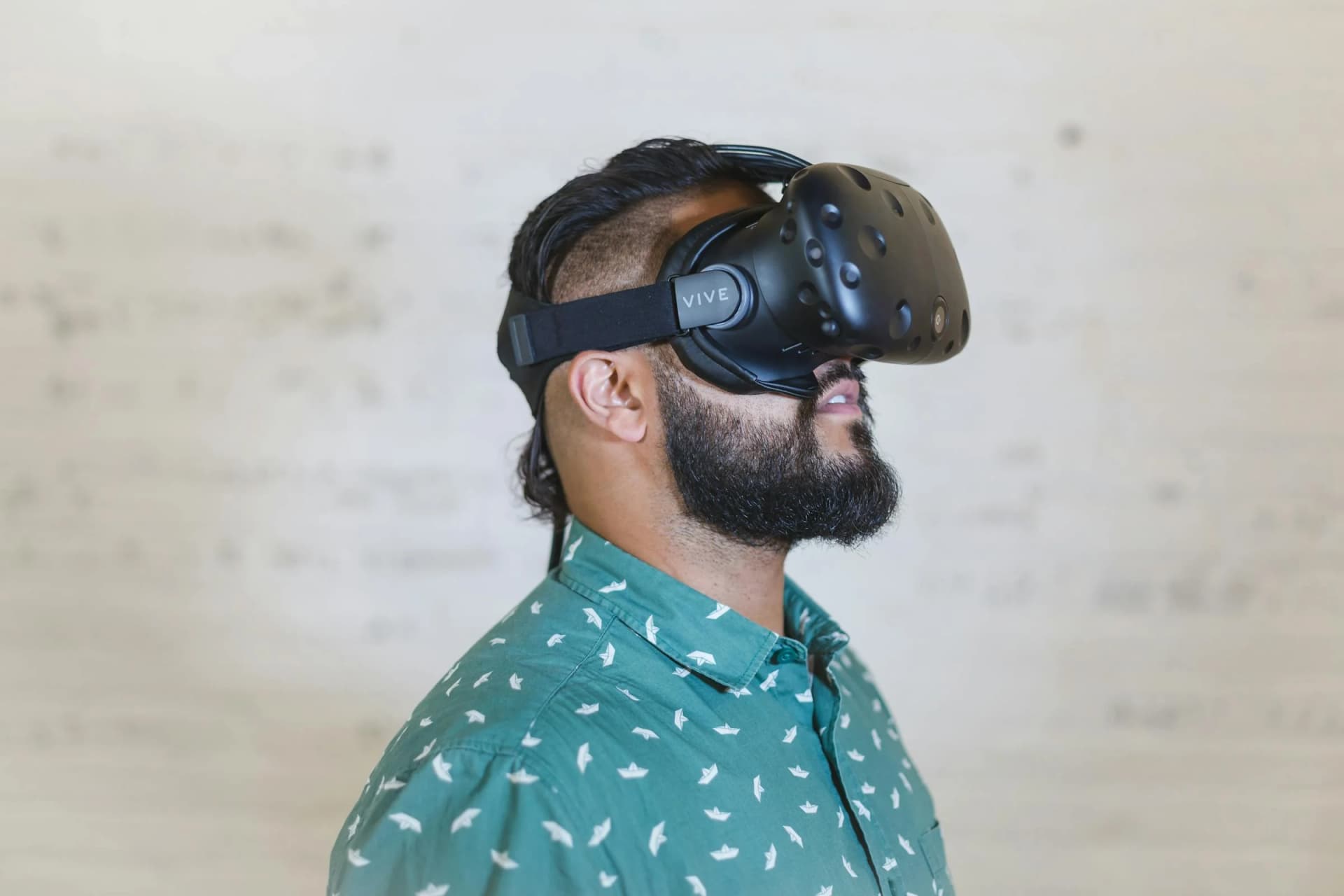
VR-based flight simulation produces measurably higher neurological engagement than desktop equivalents, with EEG beta-ratios showing large effect sizes (r = 0.48-0.58).
Beyond behavioural performance metrics, a growing body of neurophysiological research validates XR training at the neural level. Van Weelden et al. (2024) compared VR and desktop flight simulations using electroencephalography (EEG), measuring beta-ratio power — an established correlate of cognitive engagement and workload. VR produced significantly higher beta-ratios than desktop simulation across both prefrontal and parietal regions (p < 0.001), with large effect sizes (r = 0.48-0.58). Critically, higher beta-ratios correlated with improved flight task performance, suggesting that VR's enhanced immersion translates to deeper cognitive processing, not merely subjective novelty. This finding has regulatory implications: if XR can demonstrate superior neurological engagement compared to desktop trainers that already receive some training credit, the argument for expanding XR simulator credit strengthens considerably. Somerville et al. (2025) reinforce this through their motivational analysis — immersiveness was cited in 26 of 67 included studies as the primary driver of XR adoption, with deeper learning cited in 13. These are not simply user-experience preferences; they align with established cognitive load theory predictions that immersive environments promote germane cognitive load (effortful schema construction) while reducing extraneous load (interface friction). Kim et al. (2025) add a complementary dimension: their spatial disorientation experiments demonstrate that VR combined with motion cues can reliably induce specific vestibular and visual illusions, meaning VR engages not just cortical processing but the full sensorimotor pathway. Experienced F-15K pilots outperformed less-experienced pilots on the VRMS, confirming that the system discriminates meaningful expertise differences — a key requirement for any training or assessment tool. The neurophysiological evidence base, while still developing, is converging on a clear signal: XR environments produce qualitatively different neural engagement patterns compared to desktop or screen-based alternatives, and these differences map to measurable performance outcomes.
The evidence base, while increasingly favourable, contains important limitations that temper the case for wholesale XR adoption. Somerville et al. (2025) note that their meta-analysis included only 5 studies meeting quantitative synthesis criteria from 67 in the systematic review — the majority of XR training research remains qualitative, observational, or methodologically heterogeneous. Effect-size confidence intervals are wide, and publication bias toward positive results cannot be excluded. Transfer of training remains the fundamental open question. Most studies measure within-simulation performance or knowledge gains; few track whether XR-trained skills transfer to actual flight operations at rates equivalent to traditional FFS-trained skills. Ross & Gilbey (2023) explicitly call for longitudinal transfer-of-training studies comparing XR and FFS cohorts across the full skill-acquisition-to-operational-proficiency timeline. Simulator sickness (cybersickness) remains a persistent barrier. While modern headsets with higher refresh rates and improved optics have reduced incidence, susceptibility varies significantly across individuals. Kim et al. (2025) report that some pilots experienced discomfort during SD training — the very scenarios where VR is most valuable are also those most likely to induce cybersickness, creating a tension that hardware alone may not resolve. Motion cueing is another gap. Arjoni et al. (2023) established a fidelity hierarchy — simulator < real flight with AR < real flight with real aircraft — that reflects the ongoing deficit in vestibular and proprioceptive feedback from XR systems compared to physical motion platforms. High-end motion-compensated VR systems are emerging but remain expensive and complex. Standardisation is absent. There are no universally accepted frameworks for evaluating XR training device fidelity equivalent to ICAO's simulator qualification levels. Without such frameworks, regulatory credit remains ad hoc, jurisdiction-dependent, and unpredictable. Finally, the research landscape is geographically skewed toward Western military contexts. Generalisability to civil aviation, non-Western regulatory environments, and rotary-wing or multi-crew operations requires dedicated investigation.
Institutional adoption is accelerating across military, OEM, and regulatory domains. The USAF Pilot Training Next programme has moved from experiment to operational syllabus element. The US Army adopted Varjo XR-4 for the Reconfigurable Virtual Collective Trainer (RVCT) helicopter programme. Anduril's $159M SBMC contract (with Meta partnership) commits to approximately 100 EagleEye prototypes by mid-2026. Booz Allen Hamilton's 5G wireless XR system has been field-tested — the first military-grade untethered XR training deployment. Varjo's XR-4 Secure Edition (manufactured in Finland, NATO-aligned, no radio, offline-capable) addresses the classified environment barrier that previously excluded HMD-based training from sensitive programmes. On the OEM side, the Airbus VRFS represents a strategic signal: when airframe manufacturers develop proprietary XR training tools, they reduce dependency on third-party simulation companies. This vertical integration pattern mirrors Archer Aviation's Part 141 school approach in eVTOL. Regulatory engagement is increasing, though no authority has yet published XR-specific simulator qualification standards. The convergence of peer-reviewed efficacy evidence, cost pressure from pilot shortages, military operational validation, and OEM investment creates a demand signal that regulatory frameworks will eventually follow. For CAE, the strategic implications are binary: either integrate XR into the simulation portfolio as a complementary modality (leveraging Rise as the orchestration layer), or face structural disruption as the cost-fidelity frontier shifts beneath dome-based visual systems. The evidence reviewed here suggests the disruption timeline is measured in years, not decades.
USAF Pilot Training Next launched
VR-augmented syllabus; first-solo compressed to 7-8th flight
Peer-reviewed AR formation flight validation
ITA/Brazil: AR produces similar learning outcomes to real leader aircraft in Level-D FFS
EEG neurometric validation of VR training
VR produces significantly higher beta-ratios than desktop (p<0.001, r=0.48-0.58)
IVAS contract stripped from Microsoft
$22B programme failed on ergonomics and reliability
First aviation XR meta-analysis published
Somerville et al.: g=0.884, P=0.025 across 67 studies
Anduril SBMC $159M award
EagleEye prototypes with Meta partnership; ~100 units by mid-2026
SD training validated in VR motion simulator
Kim et al.: 4 illusions validated with 22 F-15K pilots
Varjo XR-4 Secure Edition shipping
NATO-manufactured, offline, classified environment capable
XR-specific training credit frameworks expected
Regulatory authorities engaging with peer-reviewed evidence base