
Operational map of CAE's capability families across civil and defense, rated as mature moat, strong adjacency, strategic bet, or comparative watch. CAE is a five-layer training enterprise, not just a simulator company.
CAE operates across five layers: regulated training, simulation equipment, training software, technical services, and defense training-system integration. Strongest in civil aviation scale, high-end FFS, defense air-domain, training centres, and platform-independent TSI. Thinner in maritime/naval visibility, land/cyber/space identity, AAM, and distributed low-cost models.
CAE operates across five layers: regulated training, simulation equipment, training software, technical services, and defense training-system integration. Strongest in civil aviation scale, high-end FFS, defense air-domain, training centres, and platform-independent TSI. Thinner in maritime/naval visibility, land/cyber/space identity, AAM, and distributed low-cost models.
CAE's revenue is split roughly 60/40 between civil and defense segments. The civil segment is driven by airline pilot training demand, while defense revenue comes from simulation systems, training services, and mission support contracts [1].
| Capability | Position | Reading |
|---|---|---|
| Global regulated pilot training | Mature moat | Regulatory credibility + 250+ FFS in 50+ locations |
| High-end simulation equipment | Mature moat | 7000XR, Prodigy, plus lifecycle aftermarket |
| Flight-ops software / digital learning | Strong adjacency | Flightscape, Rise, Pelesys extend beyond hardware |
| Advanced Air Mobility | Strategic bet | Future-readiness, not yet present moat |
| Capability | Position | Reading |
|---|---|---|
| Air-domain training systems | Mature moat | Strongest defense domain, reinforced by L3Harris acquisition |
| TSI and training centres | Mature moat | Architecture-layer and operating-partner model |
| Maritime and naval | Comparative watch | Credible but not as dominant as air identity |
| Land training systems | Comparative watch | Present but not as iconic as air or TSI |
| Cyber and space | Strategic bet | Enabling capability, not standalone leadership |
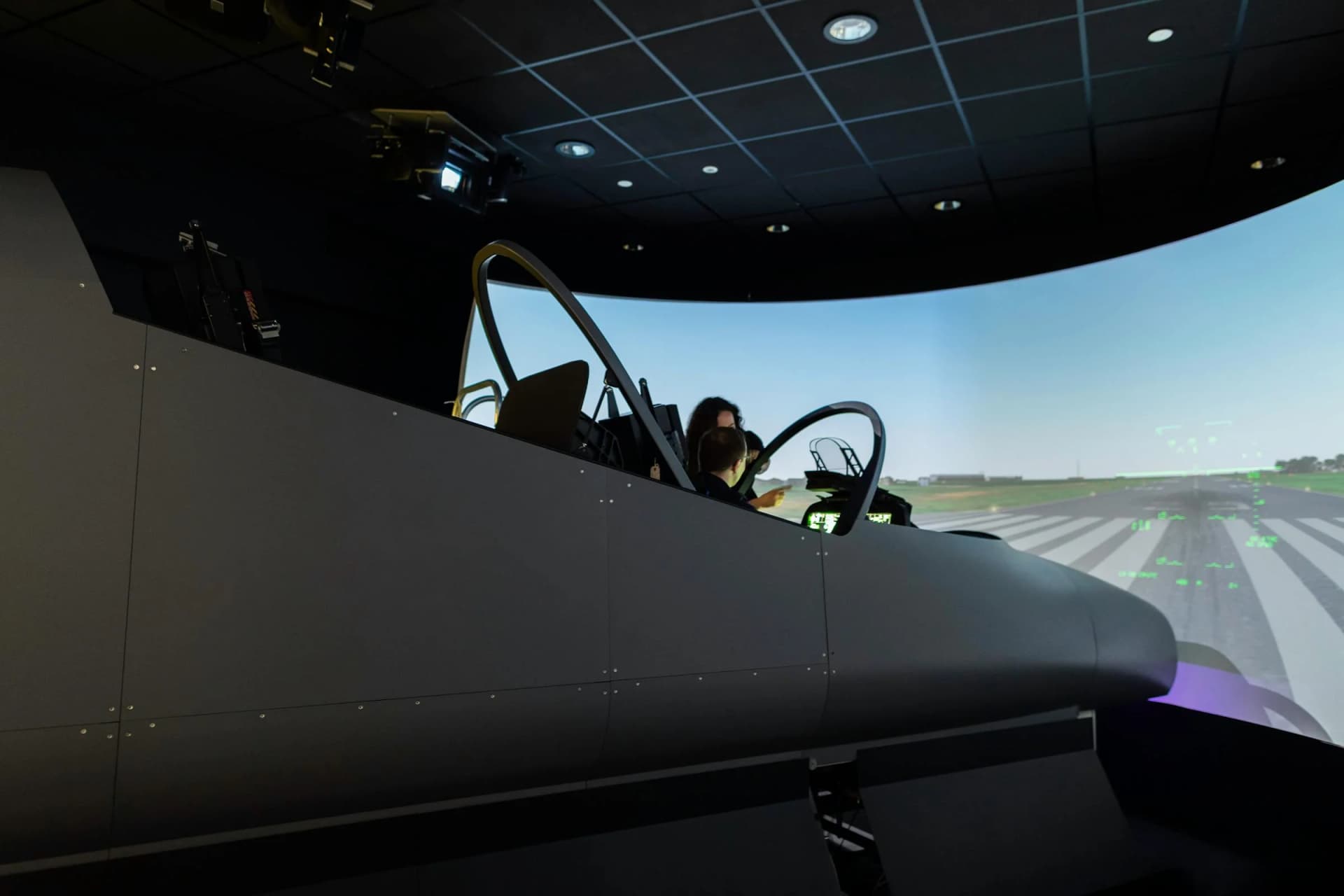
The CAE 7000XR represents CAE's highest-fidelity civil simulation platform, incorporating the Prodigy visual system for next-generation training realism.
Academic research increasingly validates that XR, AI/ML, and neurophysiological sensing are converging into a technology inflection point that will reshape simulation-based training. A systematic review and meta-analysis of XR training studies (1,237 screened, 67 assessed, 5 final studies) found a large positive effect size of 0.884 for XR-based training compared to traditional methods, indicating that immersive technologies are not merely incremental improvements but represent a step-change in training effectiveness [7]. This convergence directly supports CAE's strategic bets in the 7000XR and Prodigy visual platforms.
Machine learning is also transforming how training outcomes are assessed. Research on ML-based predictive performance assessment demonstrates that algorithms can now identify skill deficiencies and predict trainee readiness with accuracy that surpasses traditional instructor-only evaluation, enabling adaptive training pathways that compress time-to-competency [8]. Concurrently, studies on affect and performance in simulated flying tasks show that neurophysiological markers — workload, stress, engagement — can be measured during simulation sessions to create richer performance profiles [9]. CAE's Instructor Assist concept and analytics stack are well-positioned to capitalize on these converging capabilities, but the window to establish dominance is narrowing as competitors from BISim to Battle Road embed similar AI and analytics into their platforms.
The competitive implication is clear: CAE's five-layer architecture is defensible only if the software and analytics layers advance at the pace academic research suggests is possible. Competitors building software-first platforms (AtomEngine, MAK ONE, XSimVerse) will exploit any lag between research-validated capabilities and CAE's commercial deployment.