
CAE is first-mover in eVTOL simulation via Joby partnership (Level 7 FTD + Level C FFS, 250 pilots/year target). FAA selected 8 projects across 26 states. China's low-altitude economy dwarfs Western AAM (5.29M active units, $211.4B industry). Regulatory divergence (FAA vs EASA vs CAAC) creates both barrier and opportunity. Agent-based UAM system-of-systems simulation research reveals cascading cross-domain effects (vertiport delays, revenue impact), while MR training interfaces and digital twin architectures are emerging as foundational technologies for a sector with no legacy training curricula.
Joby Pilot Target/Year
Joby Through FAA Type Cert
China Active Drone Units
China Low-Altitude Industry Value
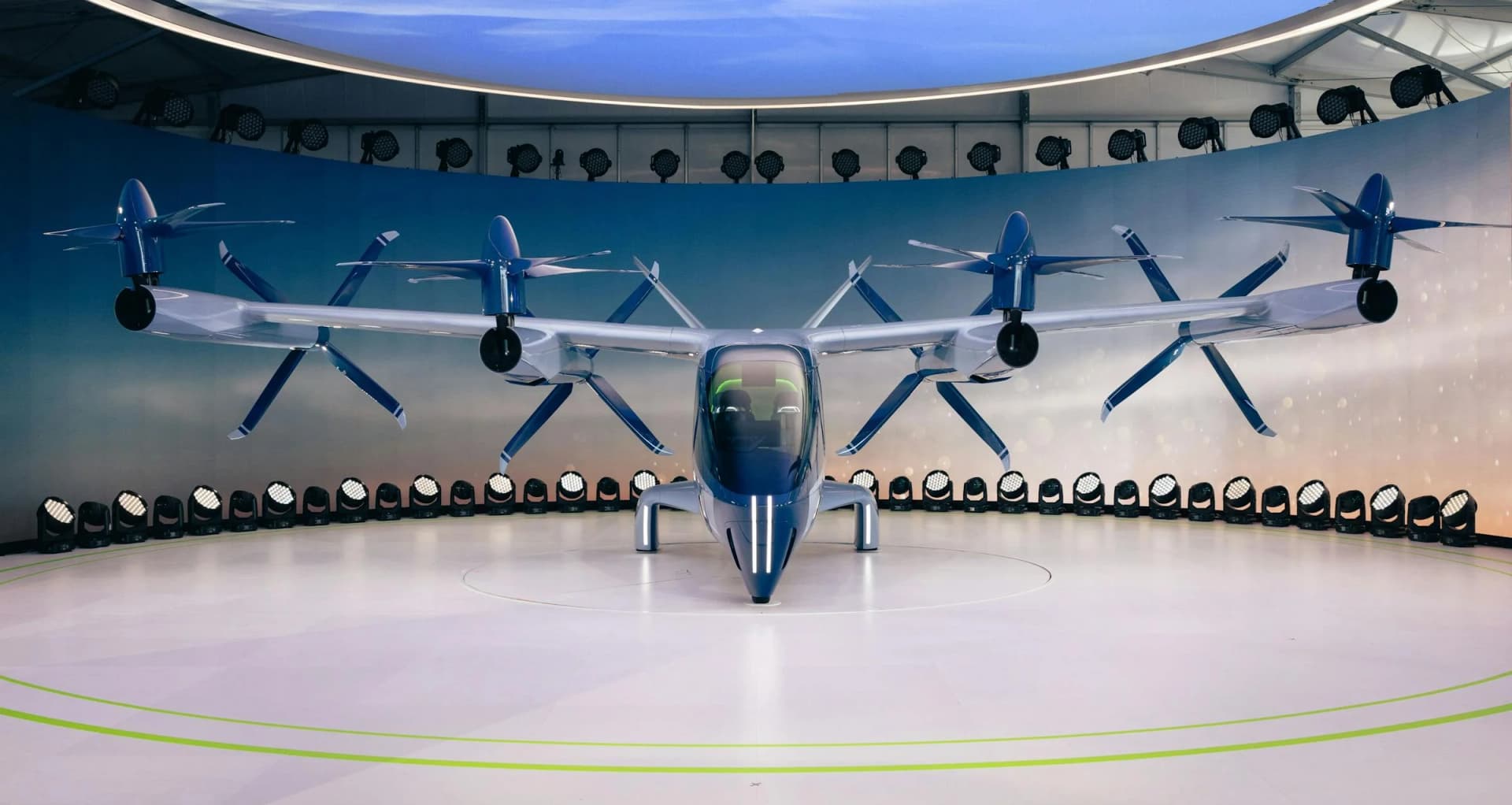
Urban Air Mobility envisions dense vertiport networks requiring new pilot competencies in confined-area operations, noise-sensitive approach profiles, and high-tempo passenger turnaround procedures — none of which exist in rotorcraft curricula.
eVTOL pilot training is unique among aviation domains: there are no legacy curricula, no incumbent training providers, and no established regulatory pathway. Unlike transitioning from one fixed-wing type to another, eVTOL operations introduce fundamentally new competency requirements — distributed electric propulsion management, autonomous flight envelope protection, vertiport-specific approach procedures, and high-density urban airspace navigation. Every OEM is simultaneously designing the aircraft, the operational concept, and the training pipeline. This creates a narrow window where simulation providers can shape the training paradigm rather than merely respond to it. The absence of an existing instructor workforce compounds the challenge: there is no pool of experienced eVTOL pilots to serve as flight instructors, making simulation-based ab initio training not a supplement but a structural necessity.

Agent-based UAM simulation integrates airspace management, vertiport operations, weather services, fleet scheduling, and passenger demand — revealing cascading cross-domain effects invisible to single-domain models.
Research on collaborative system-of-systems simulation for urban air mobility (Naeem et al., CEAS Aeronautical Journal 2024) demonstrates that eVTOL operations cannot be modelled in isolation. The DLR study built an agent-based simulation of the Hamburg metropolitan area integrating six stakeholder classes — air navigation service providers, vertiport operators, vehicle operators, passengers, weather services, and regulatory authorities — each represented by domain-specific simulation tools. The critical finding is that cross-domain knock-on effects dominate operational outcomes: vertiport congestion delays cascade into fleet scheduling disruptions, which reduce passenger throughput, which impacts operator revenue, which alters route viability. Single-domain simulation (e.g., flight dynamics alone) misses these interactions entirely. For training, this means pilot competency must extend beyond vehicle handling to include system-level decision-making — understanding how their individual flight fits within a network of interdependent operations. FAA UAM ConOps 2.0 and NASA UAM ConOps frameworks were used as the regulatory baseline, confirming that future pilot training must address concepts of operations that do not yet exist in any certification standard.
A CHI 2024 study on mixed reality eVTOL training interaction design (DOI: 10.1145/3613904.3642060) explores MR as the native interface for eVTOL pilot training, rather than retrofitting traditional cockpit simulator paradigms. Because eVTOL cockpits are fundamentally digital — glass panels, fly-by-wire, minimal mechanical controls — MR training environments can replicate the operational interface with near-perfect fidelity at a fraction of the cost of full-motion simulators. The research examines how MR enables spatial interaction patterns (3D airspace visualization, vertiport approach path overlays, traffic deconfliction displays) that are impossible in 2D panel trainers. For CAE, this represents both opportunity and threat: MR-native training could bypass traditional FFS procurement entirely if regulatory authorities accept MR as a qualifying training device. Conversely, CAE's existing relationship with headset manufacturers (Varjo XR-4 integration) and its Joby FFS program position it to define the MR training standard before competitors establish alternative paradigms.
China's low-altitude economy encompasses commercial drones, agriculture UAS, logistics, and urban air mobility — far broader than Western eVTOL air taxi focus.
| OEM | Training Model | Certification Status | Implication for CAE |
|---|---|---|---|
| Joby Aviation | Partner with CAE (FTD + FFS) | ~70% through FAA Type Cert | Anchor partnership — first-mover |
| Archer Aviation | Vertically integrated (Part 141 school) | 3 of 4 FAA certificates secured | Competitive threat — bypasses external providers |
| Lilium | N/A (insolvent Nov 2024) | Failed EASA pathway | Cautionary: certification risk is real |
FAA is leading with the powered-lift category and simulator credit pathways, having selected 8 eVTOL integration projects across 26 states. EASA trails with SC-VTOL-01 special conditions but has not finalized powered-lift simulator qualification criteria. CAAC runs a parallel track with December 2025 draft airworthiness standards. The critical regulatory gap: Level C FFS certified by FAA does not auto-transfer to EASA or CAAC. Multi-jurisdictional qualification increases cost but creates barriers to entry for competitors lacking regulatory experience. FAA UAM ConOps 2.0 and NASA UAM ConOps frameworks define the operational envelope, but neither prescribes specific training device requirements — meaning the training standard is still being written. EASA's VTOL-specific pilot licensing proposal (expected 2027) will determine whether European training requires full-motion simulation or accepts reduced-fidelity devices. An AIAA study on eVTOL training systemic approaches (DOI: 10.2514/6.2024-4214) argues that a systems-level training framework — not piecemeal adaptation of helicopter syllabi — is required to address the unique operational demands of powered-lift aircraft in urban environments.
Digital twin architectures are emerging as the connective tissue between eVTOL design, certification, operations, and training. Research on digital twins for Advanced Air Mobility (DOI: 10.3390/drones9060394) examines how persistent digital representations of eVTOL aircraft, vertiports, and airspace can enable continuous training adaptation — the simulator evolves as the aircraft software updates, rather than requiring manual reconfiguration. For a sector where OEMs push software updates to fly-by-wire systems regularly, digital twin integration ensures the training device always mirrors the current aircraft state. This concept extends to fleet-level digital twins: operators can replay actual flight data through the training simulator to create scenario libraries derived from real operational experience rather than synthetic constructs. For CAE, digital twin integration aligns directly with the Rise platform's data-connected training thesis and creates a persistent revenue stream tied to aircraft lifecycle, not one-time simulator sales.
Unlike every other aviation training domain, eVTOL has zero legacy curricula to build upon. Helicopter type ratings do not transfer meaningfully: eVTOL flight dynamics (distributed electric propulsion, wing-borne cruise transition, autonomous envelope protection) bear little resemblance to conventional rotorcraft. Fixed-wing powered-lift experience (V-22 Osprey) is military-only and operationally irrelevant to urban air taxi operations. This blank-slate condition means simulation providers are not competing to replace existing training solutions — they are creating the training paradigm from scratch. The first providers to establish certified training programs will define instructor standards, syllabi structure, and competency frameworks that subsequent entrants must conform to. CAE's Joby partnership positions it as the de facto standard-setter for FAA-pathway eVTOL training, but Archer's vertically integrated Part 141 school demonstrates that OEMs may choose to bypass external providers entirely. The window for establishing training partnerships is closing as OEMs approach type certification.
Joby FAA pilot testing
Triggers commercial pilot training demand
Archer Type Certificate expected
Determines if Archer needs external training capacity
China revised Civil Aviation Law effective
16 chapters, 262 articles, codifies low-altitude operations
FAA selects 8 eVTOL projects across 26 states
Nationwide commitment, distributed simulator demand
EASA powered-lift simulator qualification
Determines European market access for CAE simulators
DOT/FAA integration pilot results
Shapes operational training requirements for AAM
The convergence of regulatory urgency, absent legacy training infrastructure, and OEM certification timelines creates a compressed market-formation window for simulation providers. Every eVTOL OEM approaching type certification needs a training solution before commercial launch — there is no option to defer. The market opportunity extends beyond pilot training to maintenance technician training (novel electric propulsion and battery systems), vertiport operations training (ground handling, charging procedures, passenger management), and air traffic management training (new airspace integration concepts). Agent-based UAM simulation research confirms that the training challenge is not vehicle-centric but system-centric, encompassing six distinct stakeholder categories each requiring tailored simulation. For CAE specifically, the eVTOL training market represents a rare greenfield opportunity where the company's multi-domain capabilities (aviation simulation, regulatory expertise, global training centre network) align precisely with market requirements. The risk is speed: if CAE does not scale beyond the Joby anchor partnership to additional OEMs within the 2026-2028 certification wave, vertically integrated OEM training models and emerging competitors will fill the vacuum.